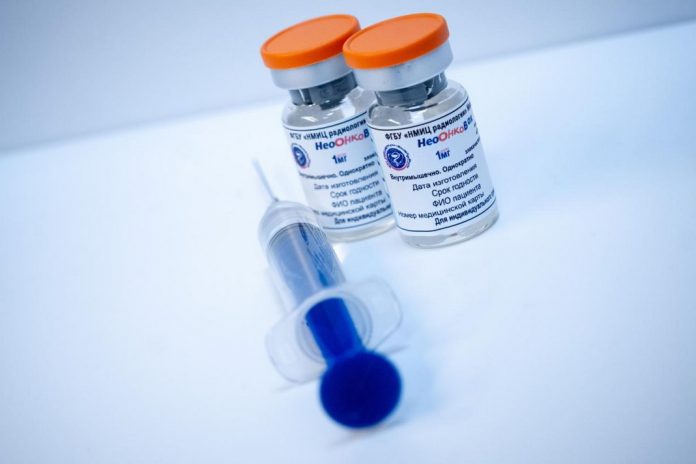
A Russian personalized antitumor mRNA vaccine, Neoovncovac, has been used in clinical practice for the first time. The administration of the drug to a patient with skin melanoma took place at the National Medical Research Center (NMRC) for Radiology of the Russian Ministry of Health.
First Patient and Therapy Regimen
The first patient is a 60-year-old resident of the Kursk region. According to the Russian Ministry of Health, despite standard immunotherapy, the patient remained at high risk of disease progression, while classical treatment options had been exhausted.
Therapy with Neoovncovac is carried out according to an approved regimen: the first injections are administered on days 1, 8, and 15 with gradual dose escalation. Subsequently, the drug is administered once every 21 days. The full course includes up to 10 intramuscular injections.
The vaccine is supplied in 1 mg vials. Individual labeling contains the patient’s full name, medical record number, and the indication “for individual use.” The drug requires strict cold chain maintenance at a temperature not higher than minus 65 °C; repeated freezing is not permitted.
Mechanism of Action and Development
The project was implemented by a scientific consortium comprising the NMRC for Radiology, the Gamaleya Center, and the N.N. Blokhin NMRC of Oncology.
The drug is created strictly individually based on the molecular genetic profile of the specific patient’s tumor. The vaccine contains information about specific tumor antigens, which allows inducing a targeted immune response to recognize and destroy malignant cells, including micrometastases.
“Today we are at a point where oncology is becoming truly personalized. This is a fundamentally different approach — not just treating the disease, but ‘teaching’ the immune system to recognize and destroy exactly those cells that pose a threat.”
— Andrey Kaprin, General Director of the NMRC for Radiology, Academician of the Russian Academy of Sciences
The final preparation of the individual dose is carried out in a specialized high-tech GMP laboratory immediately prior to administration. According to the Director of the Gamaleya Center, Denis Logunov, a specialized production complex has been commissioned at the center to manufacture such mRNA drugs.
Clinical Perspectives
Permission from the Russian Ministry of Health for the clinical use of the vaccine was obtained in November 2025. Currently, the drug is approved for the treatment of adult patients with inoperable or metastatic melanoma in combination with immune checkpoint inhibitors (ICIs), as well as as an adjuvant therapy after surgical intervention.
In 2026, regulatory changes are expected to come into force, providing for the inclusion of personalized antitumor vaccines in the state guarantee program to ensure therapy funded by the Mandatory Medical Insurance (OMC) fund. If the efficacy of melanoma treatment is confirmed, the developers plan to expand the list of indications for the use of the vaccine to other nosologies.