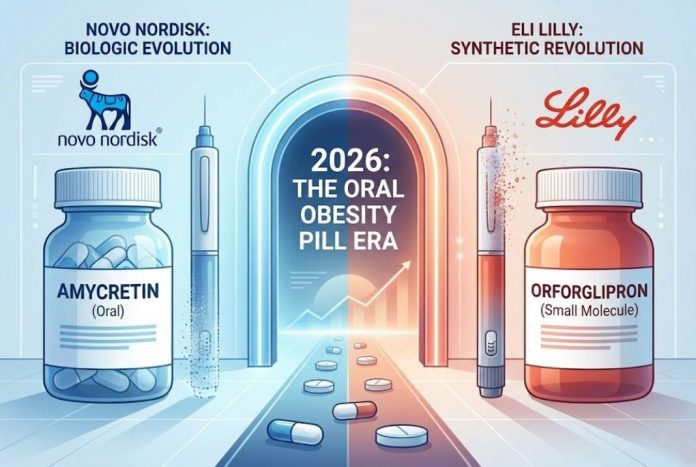
2026 marks not just the arrival of new therapies, but a fundamental shift in pharmaceutical manufacturing supply chains. The commercialization of oral obesity treatments by Novo Nordisk and Eli Lilly addresses the critical “Fill & Finish” aseptic capacity bottleneck, but opens a new front of competition: the scalability of Active Pharmaceutical Ingredients (API).
Manufacturing Insights (2026):
- Platform Shift: Transition from sterile injectables to solid oral dosage forms.
- Eli Lilly (Orforglipron): Bet on Non-peptide Small Molecules. Scalable via chemical reactors.
- Novo Nordisk (Wegovy Oral/Amycretin): Reliance on SNAC technology for peptide delivery. High API burden due to bioavailability.
- Logistics: Elimination of cold-chain requirements for new oral entrants.
Technical Deep Dive: Chemistry vs. Biology
The core differentiator between the two giants lies in the molecular nature of their assets and the synthesis methods required.
Eli Lilly: The Small Molecule Advantage
Orforglipron is a non-peptide GLP-1 agonist. From a manufacturing standpoint, this represents “classic pharma”:
- Synthesis: Produced in standard chemical reactors (Organic synthesis), offering lower costs and faster cycles than biological fermentation.
- Scalability: Does not require cell culture media. Lilly can ramp up tonnage using general-purpose CDMO facilities.
- Stability: The molecule is stable at room temperature, simplifying global distribution to emerging markets.
Novo Nordisk: The Peptide Challenge
The Danish giant continues to advance its peptide platform (Oral Semaglutide, Amycretin). This utilizes SNAC (Salcaprozate sodium) carrier technology to facilitate gastric absorption.
Production Bottlenecks:
- API Intensity: Due to low oral bioavailability (<1%), a single pill requires vastly more active ingredient than an injection. This places immense pressure on Solid Phase Peptide Synthesis (SPPS) capacity globally.
- Formulation Complexity: Granulation with SNAC requires strict humidity control and specialized lines, limiting the pool of qualified manufacturing partners.
Manufacturing Capabilities Matrix
| Feature | Orforglipron (Lilly) | Wegovy Oral / Amycretin (Novo) |
|---|---|---|
| Molecule Type | Small Molecule | Modified Peptide + SNAC |
| Production Method | Chemical Synthesis | SPPS + Fermentation |
| Packaging | Standard Blisters / Bottles (Low COGS) | Specialized Moisture-Resistant Blisters |
| CDMO Dependency | Low (Broad market access) | High (Specialized facilities) |
Analysts suggest that in the long term (2027+), the simplicity of chemical synthesis may give Eli Lilly a decisive advantage in price wars and mass market saturation, while Novo Nordisk may focus on the premium segment of high-efficacy biologics.
Source: Phase 3 Clinical Data (ACHIEVE, OASIS), Company Financial Reports. Novo Nordisk Press Office, Eli Lilly Investors