A team of scientists from the Korea Advanced Institute of Science and Technology (KAIST) has unveiled a breakthrough development in field medicine. Researchers have created a powdered agent capable of stopping severe bleeding just one second after application. Developed with the participation of an active-duty army major, the technology is poised to fundamentally improve survival rates in combat zones and disaster areas.
This was reported on December 29, 2025, by the KAIST Press Center. The research findings were published in the prestigious scientific journal Advanced Functional Materials.
Limitations of Previous Methods
Until recently, the primary means of emergency aid remained hemostatic patches. However, their flat shape is ineffective for deep, jagged, or complex wounds. Existing powdered analogs often function merely as passive absorbers, soaking up blood without creating an active barrier.
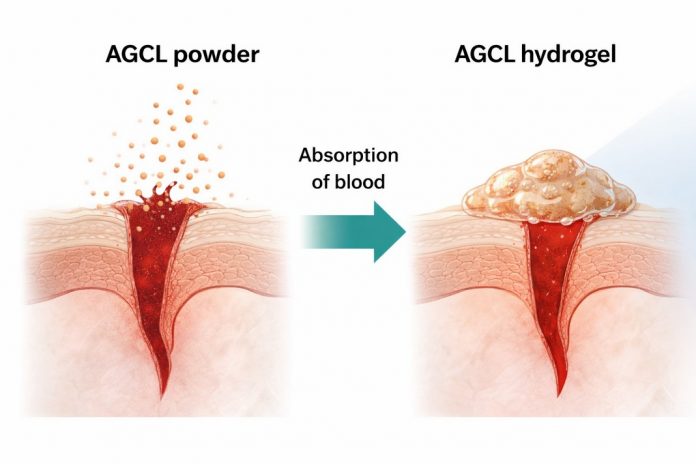
The team, led by Professors Steve Park and Sang Yong Jon, addressed this issue by creating AGCL powder, which instantly transforms into a durable hydrogel directly inside the wound.
The Secret to Efficiency: The Role of Chitosan
The key to the new agent’s success is its unique composition based on ionic reactions. The powder consists of biocompatible natural materials: alginate, gellan gum, and chitosan. Chitosan provides a comprehensive impact on the wound:
- Biological Sealing: While alginate and gum react with calcium in the blood to physically close the wound, chitosan binds with blood components at a molecular level, accelerating clotting.
- Antibacterial Protection: Thanks to the natural properties of chitosan, the powder has a 99.9% disinfecting effect, which is critically important in field conditions.
“The developed AGCL powder reacts with calcium cations in the blood, transitioning to a gel-like state in one second and instantly sealing the damaged area.”
— KAIST Research Team Press Service
Absorbency and Durability
The new material can absorb a volume of liquid exceeding its own weight by 7 times (725%). The resulting barrier in the wound withstands blood flow pressure of over 40 kPa—comparable to firm manual pressure on a wound. During experiments, organ functions in test subjects returned to normal just two weeks after applying the agent.
From Military to Civilian Medicine
A unique aspect of the study is that one of the lead authors is active-duty Army Major Kyusoon Park. This allowed the product to be adapted to harsh realities: the powder can be stored at room temperature and high humidity for two years without losing its properties.
“I began this research with a sense of mission—to save at least one more life. I hope this technology becomes an indispensable life-saving tool in both national defense and civilian medicine.”
— Kyusoon Park, Army Major, Co-author of the development
The development is considered a classic example of transferring defense technologies to the civilian sector. The powder is intended for use in disaster medicine, as well as in surgery to stop internal bleeding.
Subscribe to the PHARMPROM Email Newsletter
Pharmaceutical industry news, event announcements, and expert materials.