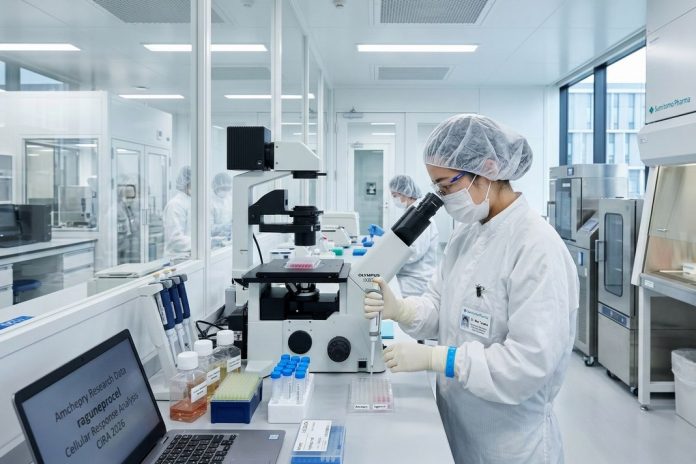
On March 6, 2026, Japan’s Ministry of Health, Labour and Welfare announced the conditional approval of Amchepry (raguneprocel). This is the world’s first commercially available regenerative medicine product based on induced pluripotent stem cells (iPS cells) for the treatment of Parkinson’s disease.
The development of Amchepry was conducted by Sumitomo Pharma in collaboration with Racthera Inc. According to official documents, the therapy is indicated for the improvement of motor symptoms in patients with Parkinson’s disease who have an inadequate response to existing pharmacological therapies, including levodopa-containing products.
Following its listing on Japan’s National Health Insurance (NHI) price list, Sumitomo Pharma will be responsible for marketing the product. The joint venture S-RACMO Co., Ltd. will serve as the contract development and manufacturing organization (CDMO). Production will take place at the specialized SMaRT facility in Osaka — the world’s first commercial-scale manufacturing facility dedicated to regenerative medicine products derived from allogeneic iPS cells.
“I hope these therapies will bring relief and save patients not only in Japan but all over the world.”
— Kenichiro Ueno, Minister of Health, Labour and Welfare
Mechanism of Action and Technological Features
Amchepry therapy is based on the use of allogeneic iPS cells. In terms of terminology and specifications:
- Composition: The product contains non-frozen dopaminergic neural progenitor cells. These are cells that have not yet differentiated into mature dopaminergic neurons.
- Mechanism: When neurosurgically implanted into specific areas of the patient’s brain, the cells are intended to restore the production of dopamine (a key neurotransmitter) to correct motor symptoms.
- Technologies: The production utilizes iPS cell lines provided by the CiRA Foundation (Kyoto University). During the cell purification stage, a proprietary technology owned by Eisai Co., Ltd. is applied.
During the Phase I/II clinical trials led by Kyoto University, the transplanted cells successfully survived and produced dopamine. No tumor formation was observed during a follow-up period of up to two years, and most patients showed improvement in motor scores on the MDS-UPDRS scale.
Regulatory Status
The product received SAKIGAKE designation (Japan’s expedited review program for innovative therapies) in February 2017 and was designated as an orphan regenerative medical product in December 2025.
The current approval is conditional and time-limited. Under Japanese regulations for regenerative technologies, Sumitomo Pharma is required to conduct post-marketing clinical studies and safety monitoring over a seven-year period. Upon confirmation of efficacy, the status will be converted into full (permanent) approval.
| Parameter | Value |
|---|---|
| INN | raguneprocel |
| Developers | Sumitomo Pharma, Racthera Inc. |
| Contract Manufacturer (CDMO) | S-RACMO Co., Ltd. (SMaRT facility) |
| Cell Material | Non-frozen dopaminergic neural progenitor cells derived from CiRA Foundation lines |
| Target Audience | Patients with an inadequate response to levodopa therapy |
| Regulatory Status | Conditional approval (data collection over 7 years) |