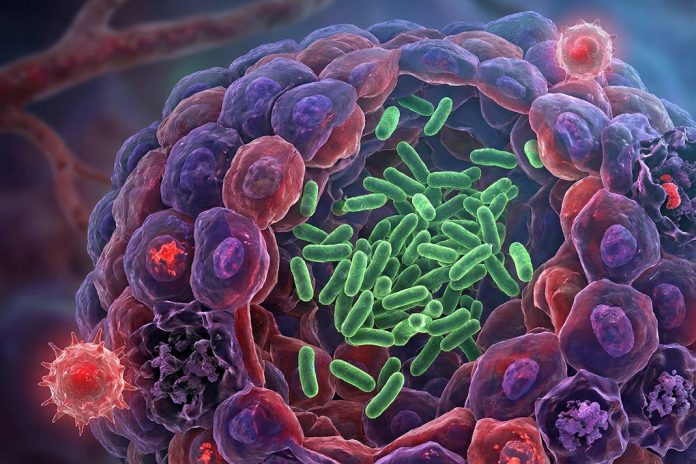
Researchers from Shandong University have modified probiotic bacteria for targeted drug delivery to solid tumors. According to a study published on March 17, 2026, in the journal PLOS Biology, these engineered probiotics can penetrate tumors and synthesize potent anticancer medication directly within the malignant tissue.
Mechanism of Engineered Probiotic Delivery
Systemic chemotherapy is often limited by severe side effects, as toxic agents affect healthy organs. To address this, a research team led by Tianyu Jiang utilized the probiotic strain Escherichia coli Nissle 1917 (EcN). This microorganism, commonly used as a beneficial supplement, possesses a natural ability to accumulate and proliferate within the specific microenvironment of solid tumors.
By reprogramming this probiotic, the researchers introduced a biosynthetic pathway for producing Romidepsin (FK228)—an FDA-approved anticancer agent naturally produced by the bacterium Chromobacterium violaceum. Through extensive genetic engineering, they achieved stable drug synthesis with a yield of 1.5 mg/L in laboratory conditions.
In Vivo Trial Results
The efficacy of this “live therapy” was evaluated in mice bearing 4T1 breast cancer cells. The experiments demonstrated that the probiotic bacteria successfully colonized the tumors and, when triggered by chemical inducers, released Romidepsin directly into the neoplastic tissue.
The therapy showed a synergistic dual-action effect:
- Direct Tumor Suppression: The Romidepsin synthesized by the probiotics inhibited tumor growth at a level comparable to traditional intravenous administration of the pure drug.
- Immune Stimulation: The presence of EcN bacteria within the tumor triggered a local inflammatory response, helping the host immune system to recognize and attack cancer cells.
Clinical Outlook
While promising, the technology requires further refinement. Future goals include ensuring the safe elimination of modified probiotics after treatment and developing non-chemical control methods, such as light-triggered or electronically signaled drug production.