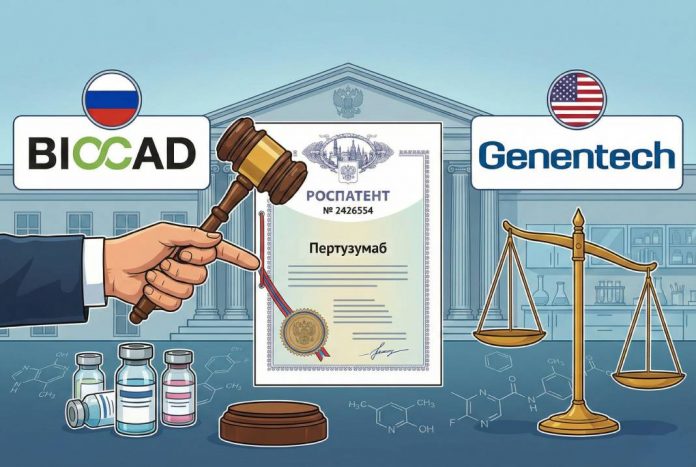
Russian biotechnology company BIOCAD failed to invalidate the patent of the American corporation Genentech for the composition of an antitumor drug. According to the conclusion of the Rospatent collegium following the consideration of the objection (No. 2024V03423), the agency denied the Russian manufacturer’s claims, leaving Russian Federation patent No. 2426554 in force.
The Essence of the Conflict
The dispute centered around the patent for a group of inventions “Antibody Compositions,” which protects the stable pharmaceutical form of the drug Pertuzumab (used to treat breast cancer). Joint-stock company BIOCAD filed an objection in October 2024, insisting that the invention does not meet the “inventive step” criterion.
BIOCAD representatives argued that the formula proposed by the American company (using a histidine-acetate buffer, sucrose, and polysorbate-20) clearly followed from the prior art and was known to specialists from earlier patents and scientific publications. The Russian company tried to prove that the choice of a buffer for antibody stabilization is a routine practice.
Defense Arguments
Genentech (the patent holder), in turn, insisted on the uniqueness of the development. The key difference was the use of a specific histidine-acetate buffer with a pH range from 5.5 to 6.5.
During the proceedings, it was proven that this particular composition provides an unobvious technical result:
- Reduced aggregation: The composition proved to be more stable under agitation and freeze-thaw cycles compared to standard histidine-chloride buffers.
- Chemical stability: The drug does not oxidize when stored in stainless steel containers, which is critical for industrial production.
Regulator’s Decision
After reviewing the arguments of the parties, the Rospatent collegium concluded that in publicly available sources prior to the priority date of the invention, there was no information on the use of a histidine-acetate buffer for Pertuzumab. The sources presented by BIOCAD described different conditions or other antibodies, which did not allow transferring this data to the disputed invention.
As a result, the agency decided to reject BIOCAD’s claims and leave the patent in force.
Rospatent’s decision cements Genentech’s monopoly on this drug formula. Previously, the validity period of patent No. 2426554 regarding the key claims of the formula was extended until March 22, 2028. This means that the market entry of biosimilars (generics) using the protected formula will be restricted until this period expires.