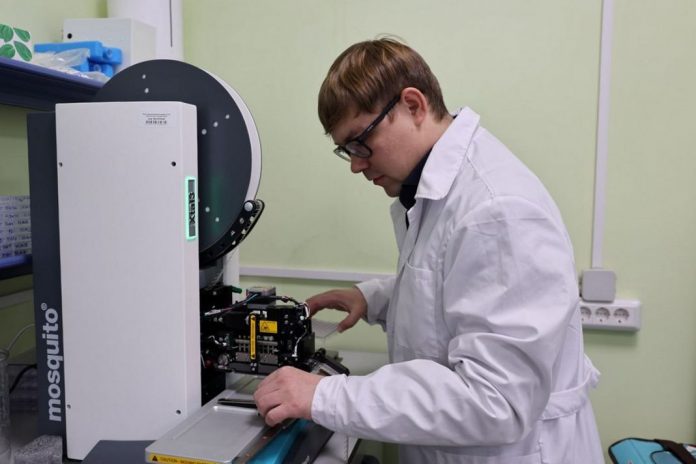
Russian science has come very close to launching one of the most ambitious projects of the decade. A unique “Crystallization” laboratory has begun work at Novosibirsk State University (NSU), where perfect protein and virus crystals are created. This was reported by the Press Service of NSU. These crystals will become the first samples for testing at the Siberian Ring Source of Photons (SKIF) — a giant “mega-science” class facility, the launch of which is scheduled for 2026.
Why Grow Crystals?
To create an effective cure for a virus or a new vaccine, scientists need to see the enemy’s structure in detail — literally every atom of the protein molecule. This can be done using powerful X-ray radiation at the SKIF synchrotron. But there is a nuance: it is difficult to study biological objects in “liquid” form. They need to be turned into crystals.
The new NSU laboratory has occupied a critically important niche: here, using molecular modeling and robots, these structures are created to then be “illuminated” at the accelerator to find the key to new treatment methods.
“We hope that the samples obtained in our laboratory will be among the very first to be investigated at the SKIF Shared Research Center. <…> The absence of synchrotron radiation sources nearby greatly slows down the speed of research conducted”.
— Sergei Arkhipov, Head of the Laboratory and Department Head at SKIF
How It Works: Robots and Space Cold
The process of creating future drugs resembles science fiction. The laboratory’s work is built on three stages:
- Digital Selection: First, scientists model the behavior of molecules on a computer, weeding out those variants that definitely will not turn into crystals. This saves months of work.
- Robotic Assembly: A robot dispenser works in a special climatic block, mixing liquids in microscopic volumes to grow crystals.
- Cryogenic Delivery: The obtained crystals are incredibly fragile matter. To transport them to the accelerator intact, a Dewar vessel with liquid nitrogen is used. Transportation takes place at a temperature of -196°C. The laboratory equipment is so reliable that it is even certified for air travel.
Hunting for Viruses
The main goal of the project is not just fundamental science, but real benefit for medicine. The laboratory works within the framework of the federal program for the development of new immunological drugs and virological research. In addition to complex biopolymers, scientists are looking for ways to crystallize low-molecular organic compounds — potential candidates for the role of new drug substances.
Personnel for Mega-Science
Since SKIF is a world-class facility, it requires top-class specialists to work on it. The new laboratory has become a base for training such personnel. For the fifth year in a row, the School of Young Scientists on the application of synchrotron radiation is held at NSU, where students are taught to work with macromolecular crystallography.
The first crystals have already been grown and are waiting for the moment when the “first light” lights up at the stations of the first stage of SKIF.