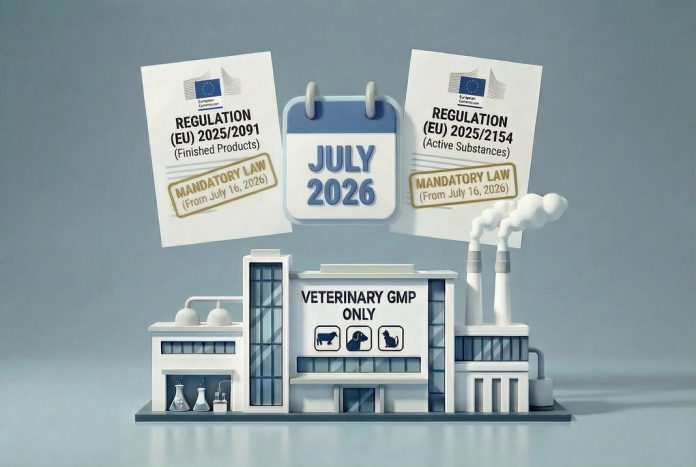
In October 2025, the European Commission published new Implementing Regulations in the Official Journal of the EU, establishing standards of Good Manufacturing Practice (GMP) for veterinary medicinal products. As of July 16, 2026, the industry transitions from the EudraLex Volume 4 guidelines to directly applicable legal norms with binding legal force.
The new regulatory framework is developed pursuant to Regulation (EU) 2019/6 and includes two key documents regulating the manufacture of veterinary medicinal products:
- Commission Implementing Regulation (EU) 2025/2091 — establishing GMP requirements for finished products;
- Commission Implementing Regulation (EU) 2025/2154 — establishing GMP for active substances (APIs) used as starting materials.
As reported by the GMP Compliance portal, the new rules will replace the existing GMP provisions for veterinary products set out in EudraLex Volume 4. Previously, these standards coincided with requirements for medicinal products for human use. Now, the veterinary sector obtains its own dedicated legal basis, although the principle of harmonization of approaches is maintained. At the same time, the regulation of the manufacture of medicinal products for human use remains unchanged under current directives.
From Recommendations to Obligations
Industry experts note a fundamental shift in the status of the documents. While EudraLex Volume 4 was a guideline allowing flexibility in interpretation, the new Regulations become binding law.
“The regulatory landscape transformation changes the terminology from recommendatory to imperative. Wording allowing variability is replaced by direct requirements (‘must’, ‘shall’). This means that compliance with standards becomes a legally binding condition for all market participants.”
— PQE Group Analysis
According to an assessment by the consulting firm PQE Group, this requirement extends to all participants in the supply chain, including API manufacturers, importers, and contract manufacturing organizations (CMOs).
Impact on Production Processes
The entry into force of the new norms will require companies to revise their internal processes. The main changes will concern:
- Pharmaceutical Quality System (PQS): Regulation (EU) 2025/2091 introduces requirements for a comprehensive quality system covering the entire product lifecycle, with an increased focus on risk management.
- Change Management: Stricter procedures for approving changes in specifications or manufacturing processes are introduced.
- Outsourcing: Client responsibility is reinforced. Even when production is outsourced to a third party, full responsibility for GMP compliance remains with the Marketing Authorisation Holder (MAH) or the manufacturer.
Particular attention will be required for facilities manufacturing both veterinary products and medicinal products for human use on the same site. From July 2026, they will have to ensure compliance with two parallel, albeit similar, regulatory systems.
To facilitate the transition, the European Commission has released tables of correspondence, allowing the new legislative norms to be mapped against the existing requirements of EudraLex.