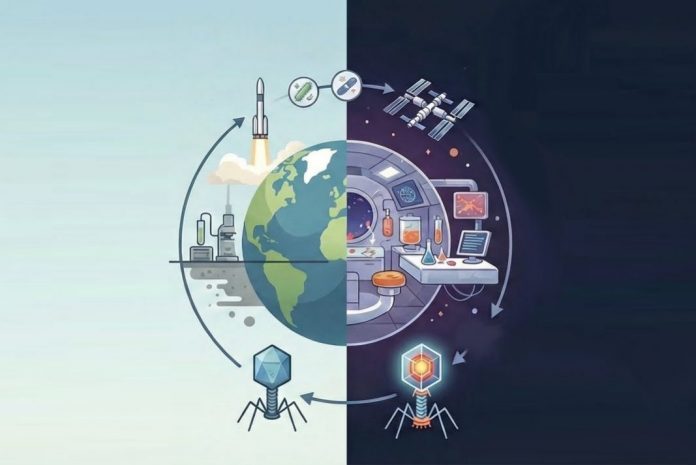
A team of microbiologists from the University of Wisconsin-Madison has unveiled results from a unique study conducted aboard the International Space Station (ISS). Scientists discovered that microgravity conditions fundamentally alter the nature of interactions and coevolution between bacteria and bacteriophage viruses. These findings open new avenues for creating drugs against antibiotic-resistant infections on Earth.
Delayed Infection in Zero Gravity
The experiment, results of which were published on January 13, 2026, in the journal PLOS Biology, focused on a classic pair: the bacterium Escherichia coli and the bacteriophage T7. The samples were delivered to the station in February 2020 aboard the Cygnus NG-13 spacecraft.
Researchers established that in space, the process of viral infection proceeds significantly slower than on Earth due to physical constraints:
| Parameter | Earth Conditions | Space (Microgravity) |
|---|---|---|
| Lysis Time | 20–30 minutes | Several hours |
| Mechanism | Active mixing, convection | No sedimentation, reduced collision probability |
Unique Mutations and a “Cosmic” Upgrade
Despite the delay, by the 23rd day of the experiment, the viruses had successfully propagated. However, their genome underwent changes not seen in terrestrial control groups. Scientists recorded the appearance of de novo mutations in both participants of the biological battle:
- Viruses: Acquired mutations in proteins responsible for binding to bacterial receptors (specifically in proteins gp7.3, gp11, and gp12). This enhanced their ability to locate and infect targets under conditions of limited movement.
- Bacteria: E. coli developed changes in outer membrane structure and metabolic processes, helping them not only adapt to stress in weightlessness but also more effectively recognize viral attacks.
Breakthrough for Earth Medicine
The most significant outcome of the work was the testing of “cosmic” virus variants on Earth. Researchers created combinatorial libraries based on mutations selected in microgravity and tested them against dangerous strains of uropathogenic E. coli (UPEC), which cause urinary tract infections.
“It turned out that the virus variants adapted in space were able to destroy terrestrial pathogens that were completely resistant to the ordinary ‘wild’ type of phage T7. Studying cosmic bacteriophages will help us design viruses capable of destroying the most drug-resistant terrestrial pathogens,” noted the study authors led by Srivatsan Raman.
Future of Research
Scientists emphasize that space acts as a unique laboratory, forcing organisms to find new survival pathways that cannot be simulated on Earth. This work lays the foundation for engineering highly effective “killer viruses” capable of tackling the threat of antibiotic resistance.
Source: PLOS Biology