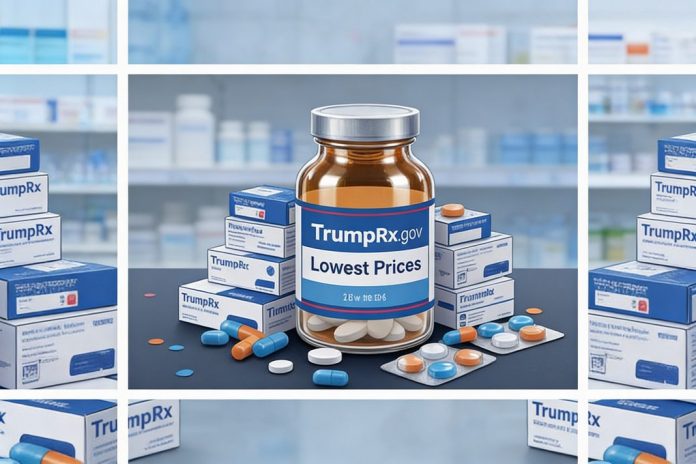
President Donald Trump officially launched the TrumpRx.gov platform on February 5, 2026. This online hub aims to provide Americans with access to prescription drugs at the “lowest prices in the world.” During the project presentation, unprecedented discounts on obesity and IVF medications were announced, made possible by a harsh ultimatum to major pharmaceutical manufacturers and a new strategy of direct state price regulation.
“America was being overcharged for medicine. The same drugs, made in the same factories, at the same dosages, are costing Americans up to 1000% more than in any other country. This is unacceptable.”
— TrumpRx.gov Manifesto
Industry Ultimatum: Tariffs in Exchange for Loyalty
The Trump administration employed unprecedented pressure tactics on the pharmaceutical sector to achieve “Most Favored Nation” (MFN) pricing. Drug manufacturers refusing White House conditions face a complex set of measures:
- Import Tariffs: The primary leverage has been the threat of prohibitive tariffs. The administration initiated an investigation viewing drug imports as a national security threat. Companies that signed the agreement (e.g., Pfizer) received a three-year “grace period” protecting them from these tariffs. [cite_start]As reported by Forbes[cite: 13], Pfizer CEO Albert Bourla called tariffs “a very big motivator.”
- Administrative “Arsenal”: Letters sent to the CEOs of 17 major companies contained a direct ultimatum with a 60-day deadline. In case of refusal, the administration promised to deploy “every tool in the arsenal” against “predatory pricing” practices.
- Public Isolation: To date, more than 16 giants, including Novo Nordisk, Eli Lilly, and AstraZeneca, have yielded to the pressure. The only major “holdout” remains Regeneron (maker of Dupixent), with negotiations continuing amidst harsh political rhetoric.
Price Shock: Weight Loss and “Trump Babies”
Amid insurance companies’ refusal to cover obesity therapy, TrumpRx offered direct discounts (averaging 50%) for cash-paying patients. [cite_start]According to CNN[cite: 15], the cost of a monthly course of Wegovy (pills) dropped to $149 (previously up to $1,349), while Zepbound injections became more accessible for the uninsured. Ozempic is also integrated into the system via a coupon mechanism.
Particular attention was paid to the “Trump Babies” project. Discounts on IVF and fertility drugs reached record highs, as these items are rarely covered by standard insurance. The price of Gonal-F plummeted from $966 to $168 per pen (83% discount), Cetrotide saw a 93% discount, and Ovidrel dropped by 67%.
“One in three families struggles to have a baby. With these prices, we’re going to have a lot of ‘Trump babies.’ This will change lives.”
— Dr. Mehmet Oz, CMS Administrator
Expansion Strategy: What’s Next?
[cite_start]At launch, the platform features 43 drug items, but as ABC News [cite: 14] reports, an aggressive expansion of the assortment is planned in the following directions:
- Adding Delayed Items: Drugs such as Januvia (Merck), announced at $100, are expected to appear in the catalog shortly.
- Finalizing Negotiations: The administration intends to pressure the “holdouts,” primarily Regeneron, to include their blockbusters in the list.
- Guarantees on New Releases: According to signed contracts, pharma giants are obligated to provide MFN pricing not only for current drugs but also for all future developments entering the US market.
- Scaling the Aggregator: The site operates on GoodRx technology. TrumpRx integrates partner coupons and expands the network of direct links to manufacturer sales channels (LillyDirect, NovoCare), acting as a single “hub” for the consumer.
Hidden Risks for Patients
Despite the triumphant announcements, experts point out the system’s limitations. TrumpRx purchases do not combine with insurance and do not count toward the insurance deductible. For holders of high-quality corporate insurance plans, prices on the platform may prove less favorable than current copays through pharmacy chains. Furthermore, skepticism remains regarding the long-term systemic effect of a model built on political pressure.