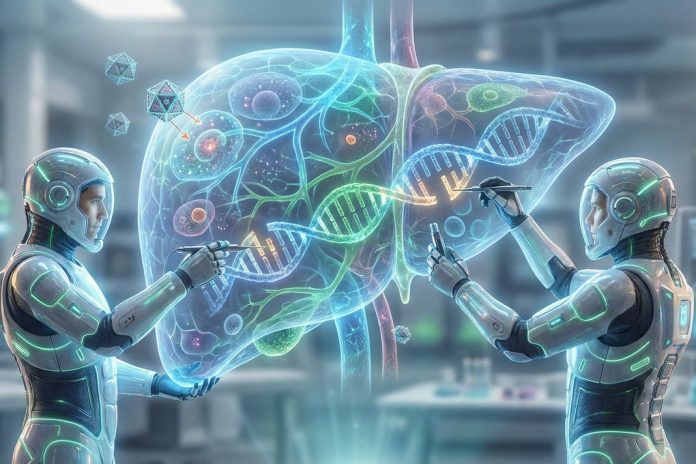
Scientists at Sechenov University have announced a breakthrough in gene therapy. For the first time in the world, an effective system for delivering CRISPR complexes has been created, allowing the complete removal of the hepatitis B virus from liver cells. This paves the way for eliminating lifelong therapy for millions of patients.
The End of an “Eternal” Disease?
Chronic hepatitis B has long been considered incurable. Existing drugs only suppress virus replication but do not destroy its genetic reservoir. As soon as the patient stops taking medication, the disease returns.
The team at the Laboratory of Genetic Technologies at Sechenov University proposed a solution they have been working on for about 10 years: not to “put the virus to sleep,” but to physically cut its DNA out of cells.
“Invisibility” Technology
The main obstacle to using “molecular scissors” (CRISPR/Cas9) was previously the delivery problem. The human body perceived therapeutic viral carriers as a threat and destroyed them with an immune attack.
Russian scientists have developed a unique non-viral system based on biodegradable nanoparticles with “bio-camouflage” technology:
- Stealth: The system does not contain foreign viral proteins, so the immune system does not attack it. This allows for repeated administration of the drug.
- Efficiency: Nanoparticles penetrate 90–95% of infected cells. One particle contains up to 250 copies of “scissors” — enough to completely clear the virus.
- Safety: The drug acts quickly and disappears from the liver without a trace within 20–24 hours.
Treatment Strategy
The developers propose a combined approach: first, classical drugs reduce viral activity, creating a “time window,” and then CRISPR nanoparticles deliver the decisive blow to viral DNA.
“Now the fundamental part of the work is already completed, we see the effectiveness and safety of the technology… There is a chance that in the coming years, the first patients will be able to receive the drug.”
— Dmitry Kostyushev, Head of the Laboratory of Genetic Technologies at Sechenov University
Universal Platform
The created delivery system can become a base not only for treating hepatitis. According to scientists, the technology can be reconfigured to fight cancer or correct genetic mutations simply by replacing the “payload” inside the nanoparticle.