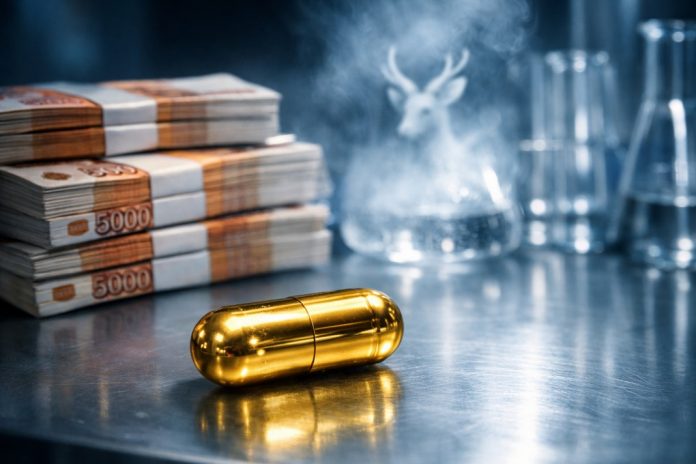
A scandal in the state pharmaceutical sector: The Accounts Chamber of the Russian Federation has reported to the President on the failure of an ambitious project to create a domestic remedy for impotence. After spending 10 years and billions of budget rubles studying the musk of the “fanged deer,” developers have not only failed to launch production but also plan to transfer rights to the drug to a private company free of charge.
Chronicle of the “Deer” Project
The story began back in 2016 when the Scientific Center for Biomedical Technologies of the FMBA launched a project to create medicines from the musk of the Siberian musk deer (a small deer with tusks). The main goal was the drug “Muskuliv” for treating erectile dysfunction, as well as remedies for stroke and traumatic brain injuries.
Expectations vs. Reality (Audit Chamber Data):
| Plan | Fact (2026) |
|---|---|
| Closed-loop production by 2020 (own nursery in Altai and laboratory in the Moscow region). | The nursery was only commissioned in 2024; the laboratory remains unfinished. An advance payment to the contractor (239 million rubles) has not been returned. |
| Own raw materials. | The drug was developed using purchased musk. Extraction at the nursery is 79% below the planned target. |
| Project Budget. | Increased 1.6 times — up to 2.4 billion rubles. |
Scheme with a Private Partner
The auditors were particularly outraged by the future fate of the development. Despite the state spending about 1 billion rubles specifically on the creation and clinical trials of “Muskuliv,” there are plans to transfer the patent and production rights to a private partner — JSC “Bryntsalov-A” (a company linked to ex-billionaire Vladimir Bryntsalov).
“Following the inspection, the Accounts Chamber sent a report to the Head of State, stating ineffective expenditure of federal budget funds. Materials have also been forwarded to the Prosecutor General’s Office,” said Auditor Sergei Mamedov.
Economics of Absurdity
Auditors calculated that even with a successful launch, the production cost of state-produced musk in 2024 amounted to an astronomical 145,000 rubles per gram. Even in an optimistic forecast by 2029, it would decrease only to 23,000 rubles, which is 5 times higher than the market price (about 5,000 rubles/g).
Market experts are skeptical. Doctors believe that musk-based preparations are closer to dietary supplements (BADs) and cannot compete with the proven efficacy of synthetic inhibitors (like sildenafil), working more as a placebo or general tonic.
Source: Izvestia