The era of explosive expansion of nomenclature in the Russian pharmaceutical market is being replaced by a period of saturation. According to fresh data from the analytical company RNC Pharma, in 2025, the rate of introducing new stock keeping units (SKUs) into circulation dropped by almost half. At the same time, Russian manufacturers have firmly secured their status as the main market driver, providing the lion’s share of new products and generating billions in revenue in the diabetes segment.
Statistics of Cooling: A Quantitative Shift
According to the “Monitoring of Drug Release into Free Circulation in the RF” database, the market has moved from a phase of active shelf-filling to qualitative rotation. While in 2024 the assortment grew by 523 items, in 2025 it increased by only 266 positions (+51 new brands). The total number of SKUs reached 15.8 thousand.
Analysts record a clear imbalance in favor of local players:
- Russian companies: expanded portfolios by 235 SKUs (total volume — more than 11 thousand positions).
- Foreign companies: added only 27 SKUs (total volume — 4.8 thousand positions).
Thus, the pace of assortment expansion by Russian factories is almost an order of magnitude ahead of the activity of foreign suppliers.
The Battle for Diabetes: 8 Billion on Tirzepatide
The main event of the year was the aggressive takeover of the market for innovative hypoglycemic agents. Russian pharma giants bet on the molecule tirzepatide (incretin class, “successors” to Ozempic) and won.
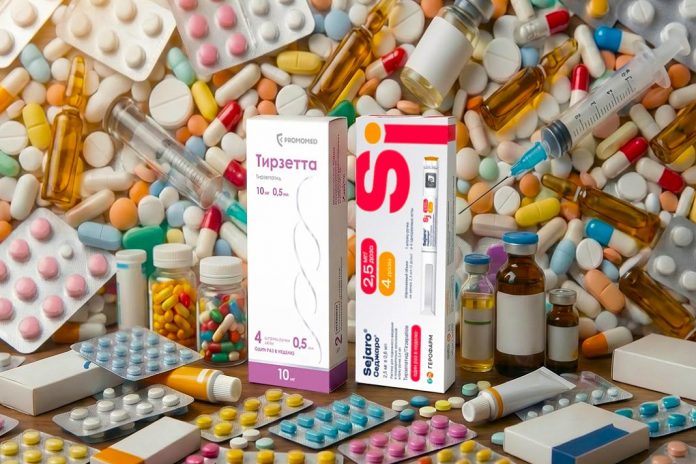
The companies Promomed and Geropharm launched drugs under the brands “Tirzetta” and “Sejaro”. The result exceeded expectations: the total sales volume of these new products for 2025 came close to the 8 billion RUB mark. This confirms the thesis that the market is ready to pay for high-tech solutions from Russian manufacturers.
Foreign players are also trying to maintain positions in endocrinology. In March 2025, two years after registration, the company Servier finally launched sales of the drug “Lusefi” (INN luseogliflozin).
New Molecules: Pain and Ophthalmology
Despite the general slowdown, 2025 brought several fundamentally new active substances to the market that had not previously circulated in Russia. RNC Pharma experts highlight the following cases:
Next-Generation Pain Relief
Promomed continues its strategy of launching modified generics (value-added medicines). In the second half of the year, sales of the drug “Rightbufen” (INN dexibuprofen) began. This is the dextrorotatory isomer of ibuprofen, which, according to the developer, has an improved safety and efficacy profile compared to classic NSAIDs.
Niche Activity of Foreigners
Bausch Health (USA/Canada) demonstrated that Western business has not completely gone into isolation, introducing new products in the ophthalmology segment:
- “Besivance” (besifloxacin) — a fluoroquinolone group antibiotic for the treatment of bacterial conjunctivitis.
- “Lotemaxin” (loteprednol) — a corticosteroid for anti-inflammatory eye therapy.
“Over the past two years, the trend towards reducing the assortment of foreign products has been replaced by weak growth. However, in terms of the number of new product items, the contribution of Russian companies today is an order of magnitude higher.”
— RNC Pharma Analytical Report